The gold of Varna
In the necropolis of Varna on the Bulgarian Black Sea coast, the dead are buried with numerous gold objects. The find is regarded as one of the oldest worked gold treasures in the world.
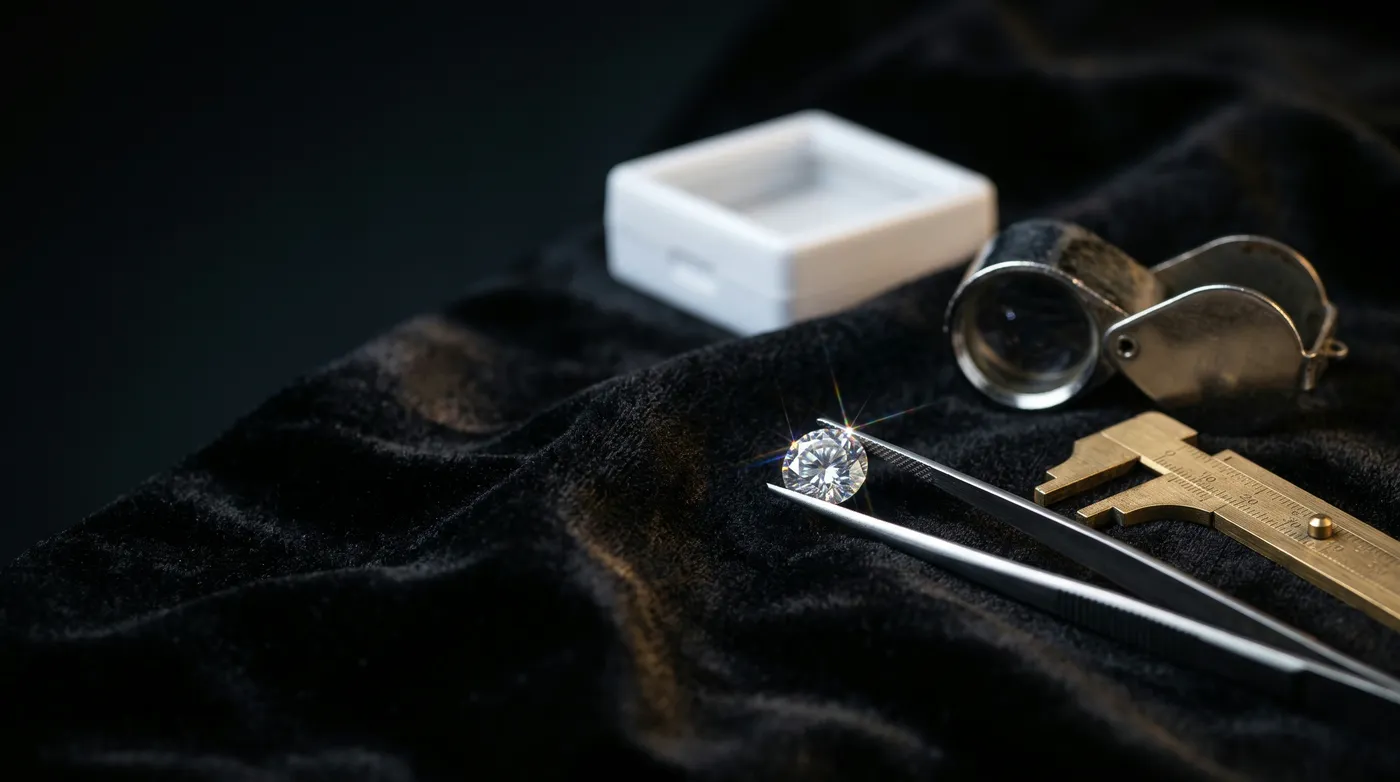
Let a diamond grow, convert ring sizes, measure your watch, explore complications and test your knowledge.

Carat, colour, clarity and cut according to the GIA system. Let the stone grow and see why double the weight does not mean double the size.
In Germany, the ring size equals the inner circumference in millimetres (EN ISO 8653). Move the slider to your circumference and read off the international sizes.
Approximate values. Manufacturer and national tables differ by up to half a size. For a ring that has to fit, it is worth having your finger measured with a ring gauge at a jeweller. Wide rings sit tighter than narrow ones.
Fineness is given in parts per thousand: 585 means 585 parts pure gold out of 1,000. How much fine gold a piece contains is worked out by the Gold Value Calculator.
| Stamp | Metal | Carat | Good to know |
|---|---|---|---|
| 333 | Gold | 8ct | An inexpensive alloy with one third gold, common mainly in Germany; it can tarnish more easily over time. |
| 375 | Gold | 9ct | Especially common in the United Kingdom, where 375 is the lowest hallmarked fineness for gold. |
| 585 | Gold | 14ct | A widespread standard for robust everyday jewellery; under the German Fineness Act also the minimum value for stamps on gold articles. |
| 750 | Gold | 18ct | The classic standard for high-quality jewellery and watch cases, with a rich gold tone. |
| 900 | Gold | 21.6ct | Typical fineness of historical gold coins, such as those of the Latin Monetary Union; rare in jewellery. |
| 916 | Gold | 22ct | Traditionally popular for jewellery in India and the Middle East, and the fineness of some bullion coins. |
| 999 | Gold | 24ct | Fine gold; very soft and therefore used mainly for bars and coins, with investment bars usually bearing 999.9. |
| 800 | Silver | n/a | Minimum fineness for stamped silver articles under the German Fineness Act, often found on older table silver. |
| 835 | Silver | n/a | Formerly common in Germany and the Netherlands, among other countries, for cutlery and jewellery. |
| 925 | Silver | n/a | Sterling silver and the international standard for silver jewellery; the rest is usually copper. |
| 999 | Silver | n/a | Fine silver; soft and used mainly for bars and bullion coins. |
| 950 | Platinum | n/a | The usual standard for platinum jewellery in Europe, for example for wedding rings and settings. |
| 999 | Platinum | n/a | Almost pure platinum for bars and coins, in some markets also for jewellery. |
| 500 | Palladium | n/a | A less expensive alloy with half palladium content, used in German-speaking countries for wedding rings, for example. |
| 950 | Palladium | n/a | A high-quality palladium alloy; naturally white and considerably lighter than platinum. |
Set the watch to a reliable time source, note the deviation after a few days and compare the daily rate with the limits of the chronometer standards.
Standards: Chronometer to ISO 3159 (COSC) · German chronometer test (DIN 8319) · COSC Excellence Chronometer · METAS Master Chronometer. The standards test movements or watches under laboratory conditions; on the wrist, temperature, position and winding change the rate.
Every additional function of a mechanical watch is called a complication. Choose one and the dial shows where it sits. The hands run in real time, and the moon phase shows today’s moon.
The simplest calendar complication shows the day of the month, usually in a window or with a hand. The movement advances one day every night and always counts on 31 days. With many mechanical movements, the date should not be set in the hours around midnight while the changeover is in progress.
A simple date has to be corrected by hand five times a year: at the end of February, April, June, September and November.
It shows how much energy is left in the mainspring, usually with a hand on a scale in hours or days. On manual-wind watches in particular, it is a timely reminder to wind.
There are 62 hours between 6 pm on Friday and 8 am on Monday, so a power reserve of three days keeps a watch that has been taken off running through the weekend.
An additional hour hand goes round the dial once in 24 hours and shows a second time zone on a 24-hour scale. This lets you read home time and local time at once, and the 24-hour division tells you whether it is day or night at home.
GMT stands for Greenwich Mean Time; the prime meridian through Greenwich was fixed by the International Meridian Conference in Washington in 1884.
The chronograph is a stopwatch built into the movement: pushers start, stop and reset an additional seconds hand, and small counters record minutes and hours. The time of day carries on running independently.
A tachymeter scale converts the time measured over one kilometre into speed: 3,600 divided by the seconds, so 20 seconds gives 180 km/h.
A disc with two moons turns behind an arched aperture and shows new moon, waxing moon, full moon and waning moon. The common version with 59 teeth counts 29.5 days per lunar cycle and is out by one day after around two years and eight months.
A synodic month, from new moon to new moon, lasts 29 days, 12 hours and 44 minutes on average.
The perpetual calendar shows the date, day of the week, month and usually the leap-year cycle, and takes the different lengths of the months, including 29 February, into account by itself. Mechanically, the calendar is usually stored in a program wheel that turns once every four years.
In 2100 most perpetual calendars will need correcting, because under the Gregorian calendar it is not a leap year.
The escapement and balance sit in a cage that usually rotates on its own axis once a minute. This averages out the rate errors that gravity causes in vertical positions. Today the tourbillon is regarded above all as a mark of fine watchmaking.
Abraham-Louis Breguet was granted the patent for the tourbillon on 26 June 1801, which in the French Republican calendar was 7 Messidor of the year IX.
At the press of a button or a slide, the watch strikes the time with small hammers on gongs: low tones for the hours, double tones for the quarter hours, high tones for the minutes. It is one of the most elaborate complications of all.
Repeater watches emerged in England in the late 17th century and told the time in the dark, long before electric light.
Mohs scratch hardness runs from 1 (talc) to 10 (diamond). Dust contains quartz with a hardness of 7: softer stones gradually turn dull with daily wear. Tap a stone.
Twelve questions on jewellery, gemstones, watches and history. After each answer you get the explanation, and at the end your result.
Goldsmiths, watchmakers and gem cutters have made history. A short journey in stages.
In the necropolis of Varna on the Bulgarian Black Sea coast, the dead are buried with numerous gold objects. The find is regarded as one of the oldest worked gold treasures in the world.
Etruscan goldsmiths decorate brooches and earrings with thousands of tiny gold beads. The technique is older, but in their hands it reaches a fineness that is still admired today.
Archduke Maximilian of Austria gives his fiancée Mary of Burgundy a ring set with diamonds. It is regarded as the earliest recorded diamond engagement ring.
Christiaan Huygens presents the spring for the balance, while Robert Hooke also claims the idea. As a result, pocket watches become much more accurate.
On 26 June 1801, Abraham-Louis Breguet is granted a French patent for his rotating escapement cage. It is meant to compensate for the rate errors that gravity causes when a pocket watch is in a vertical position.
Caroline Murat, Queen of Naples, orders a watch from Breguet on a bracelet of hair and gold thread; it is delivered in 1812. It is regarded as one of the first documented wristwatches, although the wristwatch did not catch on until the early 20th century.
Near Hopetown on the Orange River, a pebble is identified as a diamond and later named ‘Eureka’. The finds that follow around Kimberley make South Africa the leading diamond producer for decades.
Marcel Tolkowsky calculates proportions that give a round brilliant particularly high brilliance and fire. His figures still shape the modern brilliant cut today.
The Gemological Institute of America introduces its international diamond grading system based on the 4Cs. The colour scale deliberately starts at D to set itself apart from older, inconsistent systems.
In December 1954, researchers at General Electric achieve the reproducible production of diamonds under high pressure and high temperature. The first stones are tiny and intended for industry; jewellery quality only becomes economical decades later.
On 25 December 1969, the Seiko Astron goes on sale in Tokyo as the first quartz wristwatch. In the 1970s, quartz technology triggers a crisis that shakes the mechanical watch industry to its foundations.
The US Federal Trade Commission (FTC) removes the word ‘natural’ from its definition of a diamond. Under the US guidelines, lab-grown diamonds therefore count as diamonds, but their origin must be clearly disclosed.
From 4C to balance wheel. Search for a term or filter by topic.
The four criteria by which diamonds are assessed: weight (carat), colour, clarity and cut. The Gemological Institute of America (GIA) made them widely known and, building on them, created its international grading system in 1953, which today underpins most diamond reports.
Under ISO 764, a watch counts as anti-magnetic if, after exposure to a magnetic field of 4,800 A/m (around 60 gauss), its rate deviates by no more than 30 seconds per day from its previous rate. Magnets in loudspeakers, bag clasps or tablets can throw unprotected movements out of step.
In manual-wind movements, the mainspring is wound via the crown. Automatic movements also use a rotor that turns with the movements of the wrist and winds the spring by itself.
The oscillating wheel that, together with the balance spring, sets the beat of a mechanical movement. Christiaan Huygens presented the balance spring in 1675; it was what first made pocket watches truly accurate.
A mineral that includes several well-known gemstones: green emerald, blue-green to blue aquamarine and pink morganite. The colours come from traces of elements such as chromium, vanadium, iron or manganese.
A setting in which a closed metal rim surrounds the stone all the way round. It protects the edges and girdle well and is therefore suited to rings in daily use.
A round diamond in the brilliant cut with 57 facets, or 58 with a polished tip (culet). In German usage, ‘Brillant’ on its own always means a diamond; other stones are described as ‘brilliant-cut’.
A surcharge that buyers at an auction pay to the auction house on top of the hammer price. Each house sets the amount in its conditions of sale; VAT may be added.
A cut with a domed, smoothly polished top and no facets, usually with a flat base. It is particularly suited to opaque stones and to light effects such as cat’s eye or star.
The gold content expressed in 24 parts: 24 carat is pure gold, 18 carat equals 750 thousandths, 14 carat around 585. Not to be confused with the carat as a unit of weight for gemstones.
Unit of weight for gemstones: one metric carat equals 0.2 grams and is divided into 100 points. The name goes back to the seeds of the carob tree, which merchants once used as counterweights.
A watch whose movement has passed an official rate test to ISO 3159: in Switzerland by COSC, in Germany to DIN 8319 at the Glashütte observatory. For mechanical movements, the permitted mean daily deviation is −4 to +6 seconds.
A setting in which the stone is held by usually four or six metal claws. Plenty of light enters from the sides, but the claws should be checked regularly to make sure they are secure.
Any function of a watch beyond hours, minutes and seconds, such as the date, chronograph or moon phase. The perpetual calendar, tourbillon and minute repeater are regarded as particularly demanding.
A mineral of aluminium oxide with a Mohs hardness of 9. Red corundum is called ruby, corundum in all other colours sapphire; produced synthetically, it also serves as scratch-resistant watch glass.
Synthetic zirconium dioxide crystallised in the cubic system, used since the 1970s as an inexpensive diamond imitation. Not to be confused with zircon, a natural gemstone.
A pearl whose formation is initiated by humans, who insert a nucleus or a piece of tissue into a mollusc. The mollusc coats it with nacre, whose thickness and lustre (the surface sheen) determine the quality.
The assembly that passes the energy of the mainspring to the balance in even portions and releases the gear train step by step, producing the typical tick. In mechanical wristwatches, the Swiss lever escapement is the most widespread.
A ring whose band is set all the way round or halfway round with stones of equal size, often brilliants. A ring set all the way round can hardly be resized.
The proportion of pure precious metal in an alloy, expressed in thousandths. The stamp 585 means 585 parts gold out of 1,000; the rest are other metals such as silver, copper or palladium.
The glow of a stone under ultraviolet light. According to GIA, around 25 to 35% of diamonds show fluorescence, overwhelmingly blue; reports grade its strength from ‘None’ to ‘Very Strong’.
Indicates how fast the balance swings, usually in vibrations (half-oscillations) per hour (vph) or in hertz. 28,800 vph, equivalent to 4 hertz, is common; higher frequencies can improve rate stability but put more strain on the movement and mainspring.
A watch with all the components that originally came with it when sold, typically the original box, warranty card or certificate and papers. On the pre-owned market, complete watches usually fetch higher prices because their origin and authenticity are easier to trace.
A goldsmithing technique in which tiny gold beads are fused onto a metal surface to form ornaments. Etruscan workshops brought it to particular perfection in the 7th century BC.
A mark struck into metal that indicates fineness, maker or assay office. In Germany the fineness stamp is voluntary; if it is applied, it must comply with the German Fineness Act of 1884.
A movement that a maker largely develops and produces itself, as opposed to movements bought in. There is no binding definition; how many parts are made in-house varies from case to case.
Crystals, fluids or fine fractures enclosed inside a stone, usually formed during its growth. They determine the clarity grade of a diamond and, in coloured stones, can give clues to origin or treatment.
Gold in bars or wafers with a fineness of at least 995 thousandths, as well as certain gold coins of at least 900 thousandths that were minted after 1800 and are or were legal tender. In Germany its supply is exempt from VAT; this does not apply to gold jewellery or silver.
A bearing made of synthetic ruby in which the pivots of the wheels turn. The hard corundum reduces friction and wear; the number of jewels is often stated on the movement.
An international certification scheme for rough diamonds that has aimed since 2003 to stop the trade in so-called conflict diamonds. Participating states trade rough diamonds only with one another and with a certificate of origin; critics object to the narrow definition of conflict diamonds.
A diamond grown in a laboratory with the same chemical composition and crystal structure as a natural one. It is created under high pressure and high temperature (HPHT) or by deposition from a gas (CVD) and can only be reliably distinguished from a natural diamond with gemmological laboratory equipment.
A relative hardness scale from 1 (talc) to 10 (diamond), devised by the mineralogist Friedrich Mohs in the early 19th century. It indicates which mineral scratches which; the intervals are not equal, however, and diamond is many times harder than corundum at 9.
A mineral of silicon carbide, named after Henri Moissan, who discovered it in meteorite rock in 1893. Extremely rare in nature, it is now produced in the laboratory for jewellery and used as a diamond alternative with a Mohs hardness of around 9.25.
A setting style in which many small stones are set close together and held by tiny beads of metal. The surface looks paved, hence the French name.
A rare, very dense precious metal, usually worked at 950 thousandths for jewellery. It is naturally white and does not tarnish; scratches tend to displace the material rather than remove it.
The documented origin and ownership history of an object, for example through invoices, certificates or auction catalogues. A documented, significant provenance can considerably increase the value of jewellery and watches.
Electroplating with a wafer-thin layer of rhodium, a platinum group metal. This gives white gold a cool, bright lustre; because the layer wears off over time, a goldsmith can renew it.
Base metal such as brass with a gold layer applied mechanically, for example by rolling. The layer is usually much thicker and more durable than electroplated gilding, but rolled gold is not solid gold jewellery.
Gold alloys with a higher copper content, which creates the warm, reddish tone; red gold usually contains a little more copper than rose gold, although the colour names are not standardised. The fineness, such as 585 or 750, is the same as for yellow gold.
Watch glass made of synthetic corundum with a Mohs hardness of 9. In daily life it is practically scratchproof, but it can break under a hard knock.
A piece of jewellery with a single, prominent stone, classically a diamond ring. The term comes from the French ‘solitaire’, meaning single.
A silver alloy with 925 thousandths of silver, the rest usually copper. It is harder than fine silver and the standard for high-quality silver jewellery and silverware.
Processes that improve the colour, clarity or durability of a gemstone, such as heating sapphire and ruby or oiling emerald. Many treatments are common in the trade, but under the guidelines of CIBJO, the World Jewellery Confederation, they must be disclosed because they affect value.
Unit of weight for precious metals: one troy ounce equals 31.1035 grams and is therefore heavier than the ordinary ounce of around 28.35 grams. The benchmark price for gold, the LBMA Gold Price, is set twice on each London trading day in US dollars per troy ounce.
Gilded silver, today usually sterling silver with a gold layer. The minimum thickness and gold content of the layer are not set uniformly at international level.
The figure in metres or bar describes a test pressure under laboratory conditions, not a recommended diving depth. Divers’ watches to ISO 6425 must be water-resistant to at least 100 metres and meet further requirements; seals should be checked regularly.
A gold alloy whitened with palladium or other white metals; alloys containing nickel can trigger allergies, and their nickel release is limited in the EU. Because a slightly yellowish tint remains, white gold is usually rhodium-plated.
No term found. Try a different word.