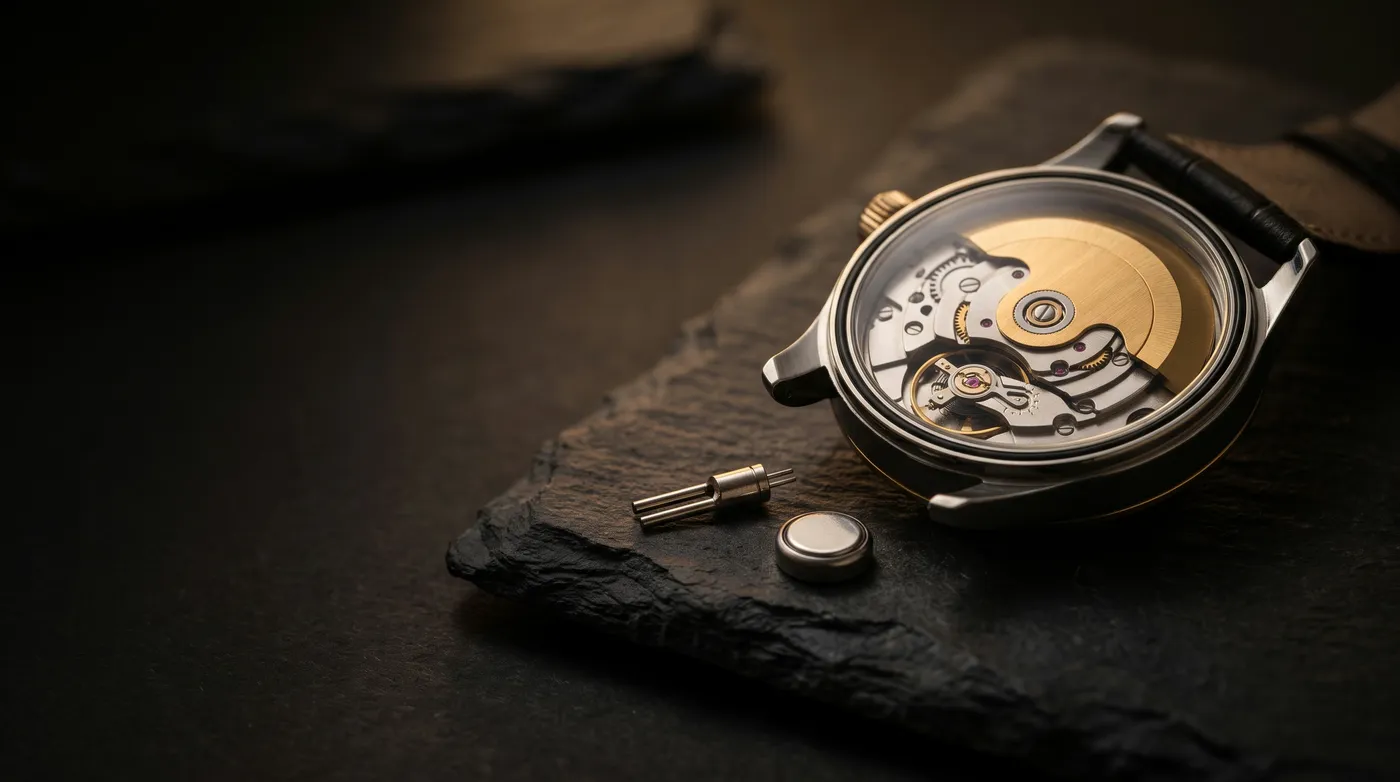

On Friday evening you put two watches in a drawer; on Monday morning you take them out again. One has stopped and needs setting. The other shows the time as if nothing had happened. Which experience you have is decided neither by the brand nor by the price, but by the movement. If you understand the three main types, you choose not on gut feeling alone, but in line with your own daily life.
The mechanical principle: storing energy, dividing time into portions
Every mechanical movement follows the same logic. The mainspring barrel houses a wound mainspring that stores energy. The gear train transmits this force towards the hands. To stop the spring unwinding in seconds, the escapement sits in between: it releases the gear train only in tiny, equal steps. The rhythm is set by the balance, a fine flywheel with a hairspring that oscillates back and forth several times a second. With each oscillation the escapement lets the gear train advance a little and at the same time gives the balance a small impulse back. The ticking you hear is exactly this exchange.
How precisely a mechanical watch runs depends on how evenly the balance oscillates. Temperature, the position of the watch and the state of wind of the mainspring all affect its rate. Manufacturers’ figures put the typical deviation for mechanical wristwatches at roughly ±5 to 45 seconds a day. Certified chronometers must meet much tighter limits in the testing laboratory; which ones is explained in the article Chronometer, COSC and METAS.
Manual-wind and automatic: the same core, two ways to charge it
With a manual-wind watch, you tension the mainspring via the crown. It becomes a ritual: ideally every day at the same time, until a noticeable resistance tells you it is fully wound. Because there is no oscillating weight, manual-wind movements are often especially thin, and a display caseback leaves an unobstructed view of the bridges and wheels.
The automatic adds a rotor to this principle. The semicircular oscillating weight turns with every movement of the wrist and winds the mainspring via a reduction gear. A slipping clutch in the barrel prevents the spring from being overwound. If you wear the watch every day, you hardly need to think about winding. If you spend a lot of time at a desk or wear the watch only occasionally, give it a few turns of the crown, provided the movement allows manual winding.
For both, the power reserve determines how long the watch runs without fresh energy. According to manufacturers, for mechanical watches this is usually around one and a half to three days after full winding; some designs run considerably longer. If you wear several watches in rotation, you will therefore often find a mechanical watch stopped after the weekend.
Quartz: precision from the crystal
A quartz watch replaces spring and balance with electronics. A battery or rechargeable cell powers a circuit that makes a tiny quartz crystal shaped like a tuning fork vibrate, in wristwatches at 32,768 hertz. The figure is no coincidence: it equals 2¹⁵. Fifteen divider stages connected in series each halve the frequency until exactly one pulse per second remains. A stepper motor converts it into the movement of the seconds hand.
The result is an accuracy measured in a different unit: manufacturers typically quote ±0.8 to 20 seconds for quartz wristwatches, and that is per month, not per day. A button cell lasts around two to ten years, depending on the movement and its functions. Quartz watches are therefore the obvious choice if a watch is to lie in a drawer for weeks and then be right straight away.
Hybrids: solar, automatic quartz and spring-driven electronics
Between the two poles, hybrids have become established. Solar watches charge an energy store via a photocell beneath a translucent dial; regular battery changes are unnecessary as long as the watch gets enough light. In automatic quartz movements, a rotor, as in an automatic watch, drives a small generator that charges a rechargeable cell. So the wearer’s movement supplies the energy, and the quartz supplies the precision.
A third group reverses the principle: a classic mainspring drives the gear train, but instead of an escapement and balance, an electronic circuit regulates the speed. A wheel driven by the gear train itself generates the current for a quartz reference, and an electromagnetic brake keeps the rotation speed in time. The seconds hand glides rather than jumping. Such movements combine mechanical drive with electronic regulation, and when it comes to servicing they belong in workshops familiar with the technology in question.
Care, servicing and the right choice
Mechanical movements use oils at bearings and contact points, and these age over time. Manufacturers therefore recommend regular servicing; published intervals range from about three years to five to eight years. What happens during a service and how to recognise the right moment is described in the article Servicing a mechanical watch.
Quartz watches need less attention, but not none. When the battery is changed, the case is opened; afterwards the water resistance should be tested. And both types react to strong magnetic fields: watches may then temporarily gain or lose time, or stop.
That leaves the question of emotion or precision. Neither type is objectively better; each answers a different question:
- Manual-wind suits you if you value daily winding as a ritual, like slim cases and wear the watch regularly.
- Automatic suits you if the watch is your daily companion and you want mechanics without an obligatory ritual. If you rotate several watches, allow for setting the time after it has stopped.
- Quartz suits you if accuracy and constant readiness matter more to you than the spectacle of mechanics, or if a watch only comes onto your wrist for special occasions.
- Hybrids suit you if you want quartz precision without regular battery changes, or would like to see spring and electronics combined.
- Ask yourself honestly: does a deviation of a few seconds a day bother you, or does it fascinate you because it shows that the watch is alive?
Before you decide: wear a mechanical watch for a week and note its deviation from the reference time every morning. After seven days you will know whether you see the seconds as a flaw or as character.
The takeaway: with quartz, precision is built in; with mechanics, it is a relationship that demands attention and care. Which additional functions a movement can carry, from the date to the minute repeater, is shown in the Complications Explorer. You can find out how accurately your own watch runs with the Accuracy Calculator.
Complications ExplorerFrom the date to the minute repeater: what the extra functions do. Accuracy CalculatorMeasure your watch and compare it with COSC and METAS.Frequently asked questions
Can you overwind an automatic watch?
Not while wearing it: a slipping clutch in the barrel lets the mainspring slip as soon as it is fully tensioned. On manual-wind movements, a noticeable resistance at the crown tells you that winding is complete. Then stop turning.
How long does a mechanical watch keep running once I take it off?
For as long as its power reserve lasts. According to manufacturers, for most mechanical watches that is around one and a half to three days after full winding. The exact figure is given in the technical data of the movement in question.
Is a quartz watch of lower quality than a mechanical watch?
Not per se. The type of movement says little about the finishing, case and materials. Quartz movements are usually much more accurate; mechanical movements are prized above all for their craftsmanship and engineering. What matters is what is more important to you.
- The Seiko Museum Ginza, Watch types compared: accuracy, power source, operating time
- Jauch Quartz, Why Do Tuning Fork Crystals Always Have A Frequency of 32.768 kHz?
- Grand Seiko, Calibre 9S instruction manual: Notes on the accuracy of mechanical watches
- Grand Seiko, Calibre 9S instruction manual: Magnetic resistance (Magnetic influence)
- Seiko, Customer Service FAQ: How often should I have the watch serviced?
- OMEGA, Customer Service: Preserve your OMEGA (service intervals)