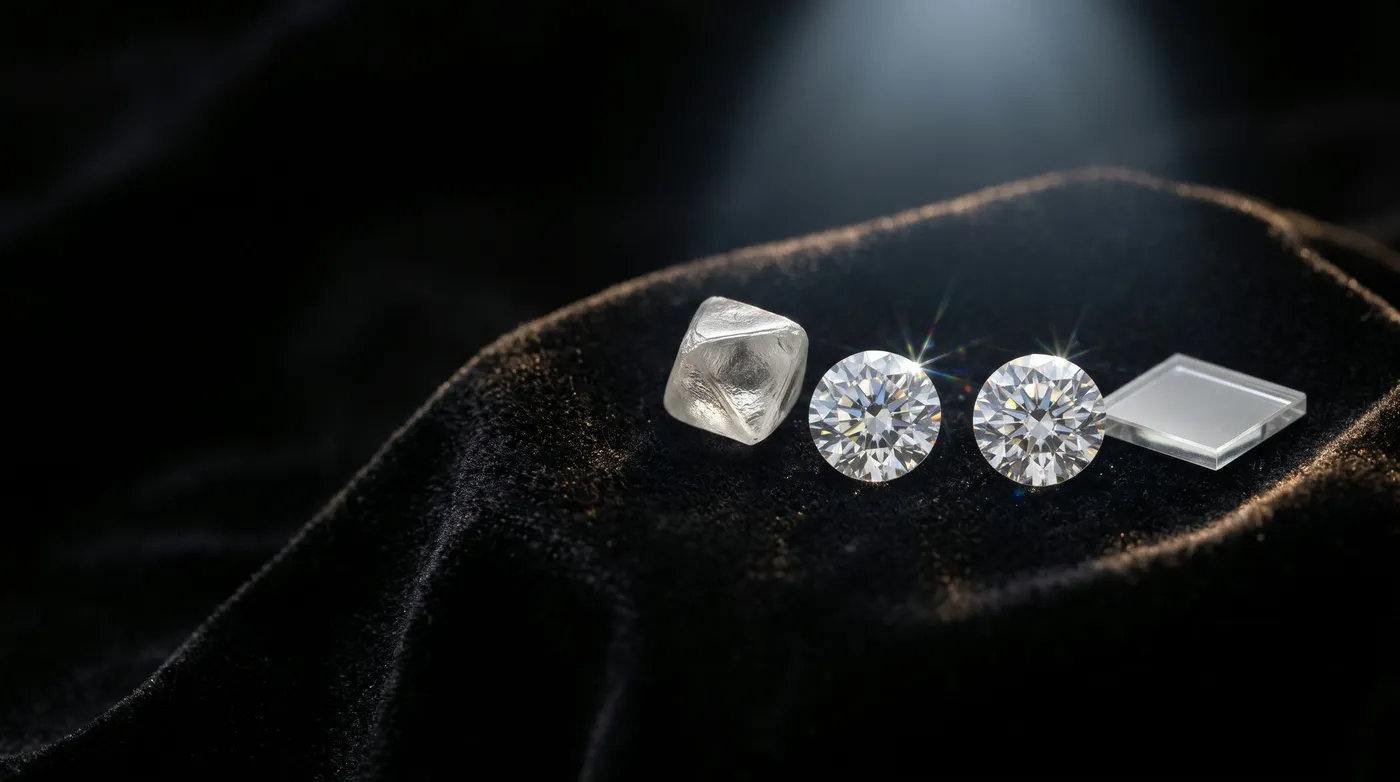

Two stones lie side by side on dark velvet: same size, same cut, the same fire. One formed deep within the earth and was brought up from a mine; the other grew in a machine in just a few weeks. No one can tell them apart with the naked eye. And yet they differ: in price, in what they may be called, on resale and in what the stone means to you. Once you know these differences, you can decide by your own standards rather than by buzzwords.
Same material, two ways of making it
A lab-grown diamond is not an imitation. Like a natural diamond, it consists of crystallised carbon; the Gemological Institute of America (GIA) describes its chemical and physical properties as essentially the same as those of natural stones. Specialists therefore call it synthetic. An imitation such as cubic zirconia, by contrast, merely copies the appearance.
The HPHT process (High Pressure, High Temperature) uses a press to recreate the conditions deep inside the earth. According to the GIA, the growth chamber reaches 1,300 to 1,600 °C and a pressure of more than 870,000 psi, roughly 60,000 bar. Carbon, such as graphite, dissolves in molten iron, nickel or cobalt and crystallises over days to weeks on a small diamond seed.
The CVD process (Chemical Vapour Deposition) works in a vacuum and at much lower pressure. In a chamber at 900 to 1,200 °C, microwaves break down a mixture of hydrogen and a carbon-bearing gas such as methane. The carbon is deposited layer by layer on flat diamond plates; according to the GIA, one run takes three to four weeks. Some stones are treated further after growth, for example to improve their colour.
How laboratories spot the difference
The way a stone forms leaves traces that only expertise and instruments can reveal. HPHT stones may contain metallic inclusions from the molten metal, and some even respond to a magnet. CVD stones often show banded strain patterns under polarised light. Under short-wave UV light, synthetic diamonds often fluoresce more strongly. Specialist cameras make the growth structure visible: concentric patterns point to a natural stone, cross-shaped ones to HPHT, fine striations to CVD. Small pavé stones are screened by automated devices.
The GIA laser-inscribes every lab-grown diamond it examines with the words ‘Laboratory-Grown’ and a report number. The origin is only proven, however, when the number, the grading report and the laboratory’s database entry all match. Five questions will keep you on safe ground when you buy:
- Terminology: Does ‘synthetic’ or ‘laboratory-grown’ appear right next to the word diamond, on the label, the offer and the invoice alike?
- Grading report: Does an independent laboratory state the origin explicitly?
- Inscription: Does the number on the girdle match the report?
- Small stones: Have pavé and accent stones been tested, even if they have no report of their own?
- In writing: Is the origin recorded on the invoice, not merely promised verbally?
What the label must say
The Diamond Terminology Guideline, published in 2019 by eight industry organisations including the World Jewellery Confederation CIBJO, is based on the ISO 18323 standard and CIBJO’s Diamond Blue Book. Under it, ‘diamond’ without qualification always means a natural stone; for lab-grown diamonds, the terms ‘synthetic’, ‘laboratory-grown’ or ‘laboratory-created’ are to be used. Abbreviations such as ‘lab-grown’ should be avoided, as should ‘cultured’ and words such as ‘real’, ‘precious’ and ‘natural’.
In September 2026 CIBJO went further: its board recommends using only ‘synthetic’ as the technical term in the Blue Books, and recognises ‘laboratory-grown’ as a consumer term that is accepted in some jurisdictions; national law takes precedence. In the United States, the Jewelry Guides of the trade regulator FTC require a clear qualifier such as ‘laboratory-grown’ or ‘laboratory-created’ for stones that were not mined; even ‘cultured’ is permitted only with such a qualifier. In Germany, the ban on misleading practices under competition law applies, and it expressly counts the type, composition and method of manufacture of goods among their essential characteristics.
Price and resale
The clearest difference is in price. According to Bain & Company’s diamond industry report, the average retail price of polished lab-grown diamonds in 2021 was around 30% of the price of comparable natural diamonds, and 14% at wholesale. A year earlier the figures had been 35% and 20%. Wholesale prices have fallen further since then. The analyst Edahn Golan, who tracks cash trades in certified lab-grown diamonds in Mumbai and Surat, records a 96% fall in his wholesale index since July 2018. In the second quarter of 2026, prices overall were 13% below the previous year, while round one-carat stones were 1% higher.
For buyers, this cuts both ways. A lab-grown diamond puts size and quality within reach at a fraction of the price. On resale, however, a used stone competes with new goods whose prices have been falling for years. Even with natural diamonds, the buy-back price is usually below the purchase price, because the retail margin, the setting and the tax are not recovered. This article is not investment advice.
Sustainability: look closely
Sweeping judgements are misleading here. A lab-grown diamond needs no mine, but its growth requires high temperatures, high pressure or a microwave plasma over days and weeks, and therefore a great deal of energy. How large its footprint is depends heavily on where the electricity comes from. Natural diamonds involve intervention in the landscape; at the same time, mining is a significant industry in some producing countries. Since 2003, the Kimberley Process Certification Scheme has been intended to prevent the trade in rough diamonds from financing armed conflict; a comprehensive assessment of environmental and working conditions is not its purpose.
Be wary of green buzzwords: in 2019 the FTC sent warning letters to eight jewellery companies, partly over unsubstantiated terms such as ‘eco-friendly’ and ‘sustainable’. In Germany, since 27 September 2026, generic environmental claims such as ‘environmentally friendly’ or ‘sustainable’ have been prohibited unless they are based on recognised excellent environmental performance; this is how Germany implements EU Directive 2024/825. So ask for specifics: energy source, place of production, verifiable evidence.
Don’t just take the origin on trust: get it in writing. The invoice should state the exact designation of the stone (‘diamond’ or ‘synthetic diamond’), the carat weight, colour, clarity and the grading report number.
The upshot: lab-grown or natural is not a question of real or fake, because mineralogically both are diamond. It is a question of origin, price development and personal meaning, and you answer it best with documents rather than promises. The 4C Explorer shows how carat, colour, clarity and cut work together. Which metal holds the stone securely in everyday life is covered in the article Platinum, white gold, palladium.
4C ExplorerUnderstand carat, colour, clarity and cut interactively.Frequently asked questions
Can a jeweller spot a lab-grown diamond with the naked eye?
As a rule, no. According to the GIA, colourless CVD stones can look exactly like natural diamonds to the naked eye. Certainty comes from gemmological testing equipment and a report from an independent laboratory.
May a lab-grown diamond be called ‘real’?
Chemically and physically, it is a diamond. However, the international industry guidelines reserve terms such as ‘real’, ‘precious’ and ‘natural’ for natural diamonds. For lab-grown diamonds, qualifiers such as ‘synthetic’ or ‘laboratory-grown’ are to be used, placed directly next to the word diamond.
Does a lab-grown diamond hold its value?
Wholesale prices for lab-grown diamonds have fallen sharply since 2018, though not evenly across all sizes. If you expect to resell, you should factor that in. This is not an investment recommendation, either for lab-grown or for natural diamonds.
- GIA, HPHT and CVD Diamond Growth Processes
- GIA, Identifying Lab-Grown Diamonds
- GIA 4Cs, Laboratory-Grown Diamond Reports (laser inscription)
- Diamond Terminology Guideline (AWDC, CIBJO, DPA, GJEPC, IDI, IDMA, WDC, WFDB), 25 September 2019
- CIBJO, Board recommendation on the term ‘synthetic’ (September 2026)
- FTC Jewelry Guides, 16 CFR § 23.12 (definition and labelling of diamonds)
- FTC, FTC Sends Warning Letters to Companies Regarding Diamond Ad Disclosures (2 April 2019)
- § 5 German Act against Unfair Competition (UWG)
- Bain & Company / AWDC, A Brilliant Recovery Shapes Up: The Global Diamond Industry 2021 to 2022
- Edahn Golan, The Q2 2026 LGD Wholesale Price List (InStore, 8 July 2026)
- Bonn/Rhein-Sieg Chamber of Industry and Commerce (IHK), Greenwashing: new prohibitions in the UWG
- Trade and Industry Department Hong Kong, Kimberley Process Certification Scheme for Rough Diamonds