
You turn an inherited ring towards the light. On the inside are three tiny digits, 585, and next to them a symbol you can’t place. Is that a lot of gold or a little? Will the ring stand up to everyday wear, will your skin tolerate it, and what would it be worth if you sold it? The number reveals a great deal, but not everything.
Parts per thousand and carats
The stamp states the fineness: how many of 1,000 parts by weight are pure gold. 585 means 585 parts fine gold; the remaining 415 parts are other metals such as silver, copper, zinc, palladium or nickel. The older carat system divides the same ratio into 24 parts: 24 carat is pure gold, 18 carat corresponds to 750 parts per thousand. The conversion is simple: parts per thousand times 24, divided by 1,000. Mathematically, 14 carat works out at 583.3 parts per thousand; the stamp usually reads 585, sometimes 583.
The low finenesses 333 and 375 contain only a third and three eighths gold respectively, and correspondingly more of other metals. 585 and 750 are the classic finenesses for jewellery. You will come across 900 and 916 mainly in coins: under the German VAT Act, gold coins of 900 parts per thousand or more that were minted after 1800 and are or were legal tender count as investment gold, subject to further conditions. 999 stands for fine gold, which is very soft for rings worn every day.
What the stamp means in law
In Germany, the Act on the Fineness of Gold and Silver Wares of 1884 governs these marks. Gold may be worked in any fineness. Anyone who states the fineness on jewellery must give it in parts per thousand; the law allows a tolerance of no more than ten parts per thousand, measured on the completely melted-down piece. For gold articles such as cutlery or tableware, a minimum fineness of 585 applies. The seller is liable for the accuracy of the mark. Imported goods whose fineness mark does not meet German requirements may only be offered for sale if they are additionally stamped in accordance with the Act.
German law does not require an official assay before sale, and Germany is not one of the 22 contracting states of the Vienna Hallmarking Convention. The convention’s Common Control Mark (for gold, a pair of scales above two intersecting circles) also requires a fineness mark alongside it. In the United Kingdom, by contrast, gold articles for the domestic market must in principle be officially hallmarked. The German Fineness Act does not require a maker’s or sponsor’s mark on jewellery, although many pieces carry one anyway. In Germany, then, the stamp is a declaration by the manufacturer or dealer, not an official seal. For a piece of unknown origin, expert testing provides certainty, for example by X-ray fluorescence analysis.
Colour, hardness and everyday wear
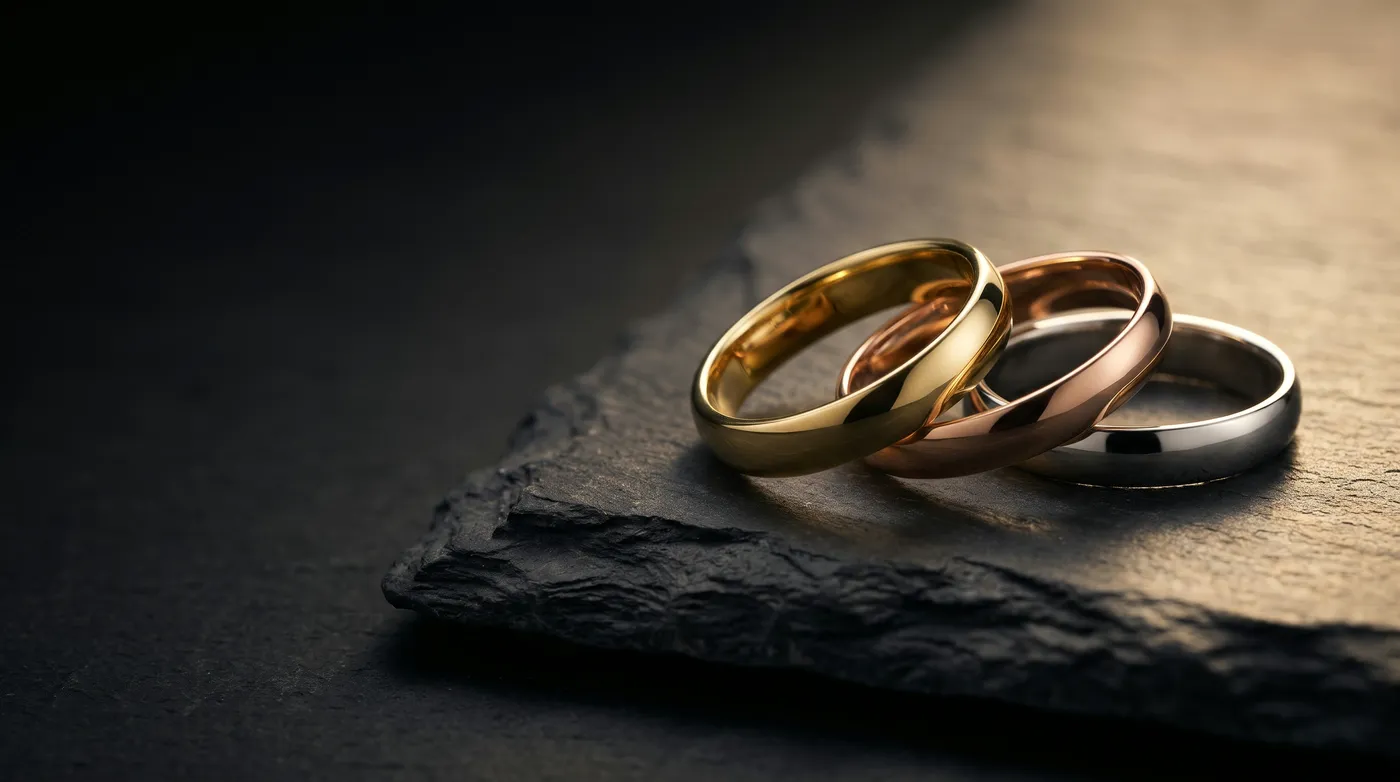
The colour is determined by the alloying metals. Yellow gold is typically alloyed with silver and copper; for 18 carat, the World Gold Council gives the example of 15% silver and 10% copper. Rose and red gold get their warm tone from a higher proportion of copper. White gold is made with white metals such as palladium or nickel. It is usually rhodium-plated as well: a layer of rhodium gives a cool white, more lustre and a harder surface. It wears away over time, and the ring then looks warmer in tone. Fresh rhodium plating at the goldsmith’s restores the white.
Pure gold is soft and picks up scratches and dents easily; only alloying makes it hard-wearing. The GIA considers 14 and 18 carat gold suitable for everyday wear. 750 offers a richer tone and more precious metal, while 585 contains more alloying metals. With very low finenesses such as 333, the proportion of base metals is so high that the surface is more prone to tarnishing. How durable a piece is, however, also depends on the alloy and the workmanship, not on the stamp alone.
Nickel, copper and your skin
According to Germany’s Federal Institute for Risk Assessment, nickel is the contact allergen with the highest sensitisation rate; around 10% of all children are already sensitised. White gold may contain nickel, and the GIA advises people with a nickel allergy to avoid such alloys. If you react to copper, you should also ask about yellow and rose gold.
In the EU, the REACH chemicals regulation limits the nickel release from articles that come into direct and prolonged contact with the skin to 0.5 µg per square centimetre per week; for posts inserted into pierced parts of the body, such as earlobes, the limit is 0.2 µg. A limit value is not a ban on nickel, however, and not every piece complies: in 2021/2022 the Bavarian Health and Food Safety Authority objected to four out of 27 samples of jewellery and wristwatches ordered online because of excessive nickel release. A quick check before you buy helps:
- Fineness: in parts per thousand, on the piece and on the invoice.
- White gold: ask about the alloy (with palladium or with nickel) and whether the piece is rhodium-plated.
- Weight: have it noted in grams; it is the basis of any valuation.
- Earrings: if your skin is sensitive, pay particular attention to nickel-free posts.
- Imported goods: check whether parts per thousand are stamped alongside any carat mark.
Material value is not the selling price
The material value can be calculated precisely: weight times fineness times gold price. A 6 gram ring in 585 contains 6 × 0.585 = 3.51 grams of fine gold. The selling price of a piece of jewellery is almost always higher, because it also covers design, craftsmanship, stones, retail margin and VAT. In Germany, gold jewellery is subject to the standard VAT rate of 19%; under § 25c UStG, only investment gold is tax-exempt, such as bars of 995 parts per thousand or more. Conversely, buying prices for old gold are based on the fine gold content, minus the cost of assaying and refining. If you are selling, you should therefore know your fine gold content and compare offers. This is not an investment recommendation: jewellery is bought first and foremost to be worn.
Read stamps with a 10× loupe and photograph them for your records. If you find only a carat mark such as ‘18K’, convert it: 18 divided by 24 gives 750 parts per thousand.
The upshot: the stamp tells you how much gold a piece contains, but not how well it is made, how your skin will take to it or what a dealer will pay for it. Those questions are answered by the alloy, the workmanship and the weight. The Gold Value Calculator works out what your ring contains from its weight and stamp. How white gold compares with platinum and palladium on the finger is shown in the article Platinum, white gold, palladium; terms from fineness to rhodium plating are explained in the Glossary.
Gold Value CalculatorEnter weight and stamp to see the fine gold and material value.Frequently asked questions
Is 333 gold real gold?
It is a gold alloy containing one third fine gold. German fineness law allows jewellery to be made and stamped in any fineness, provided the mark is given in parts per thousand and is accurate. Because of its high proportion of other metals, 333 gold is more likely to tarnish than higher alloys.
Why is my white gold ring turning yellowish?
Usually the rhodium layer has worn off, revealing the warmer tone of the alloy beneath. A goldsmith can re-plate the ring with rhodium.
Is 750 gold better than 585?
750 contains more fine gold, has a richer tone and a higher material value; 585 contains more alloying metals. According to the GIA, both are suitable for everyday wear. What matters is your taste, your skin and the workmanship.
- Act on the Fineness of Gold and Silver Wares (FeinGehG), Germany
- § 25c German Value Added Tax Act, UStG (taxation of transactions in investment gold)
- § 12 German Value Added Tax Act, UStG (tax rates)
- GIA 4Cs, Guide to White, Yellow, and Rose Gold Engagement Rings
- GIA 4Cs, Best Ring Material for Everyday Wear
- GIA 4Cs, Choosing Between White Gold, Platinum, Palladium, and Silver
- World Gold Council, Gold Jewellery: Colour, Carat & Purity
- World Gold Council, Gold Jewellery Hallmarks & Makers Marks
- Hallmarking Convention, Contracting States
- German Federal Institute for Risk Assessment (BfR), High nickel release from metal construction kits can trigger allergies (press release 30/2013)
- Bavarian Health and Food Safety Authority (LGL), Nickel in consumer goods with skin contact
- Bavarian Health and Food Safety Authority (LGL), Nickel release from jewellery sold online