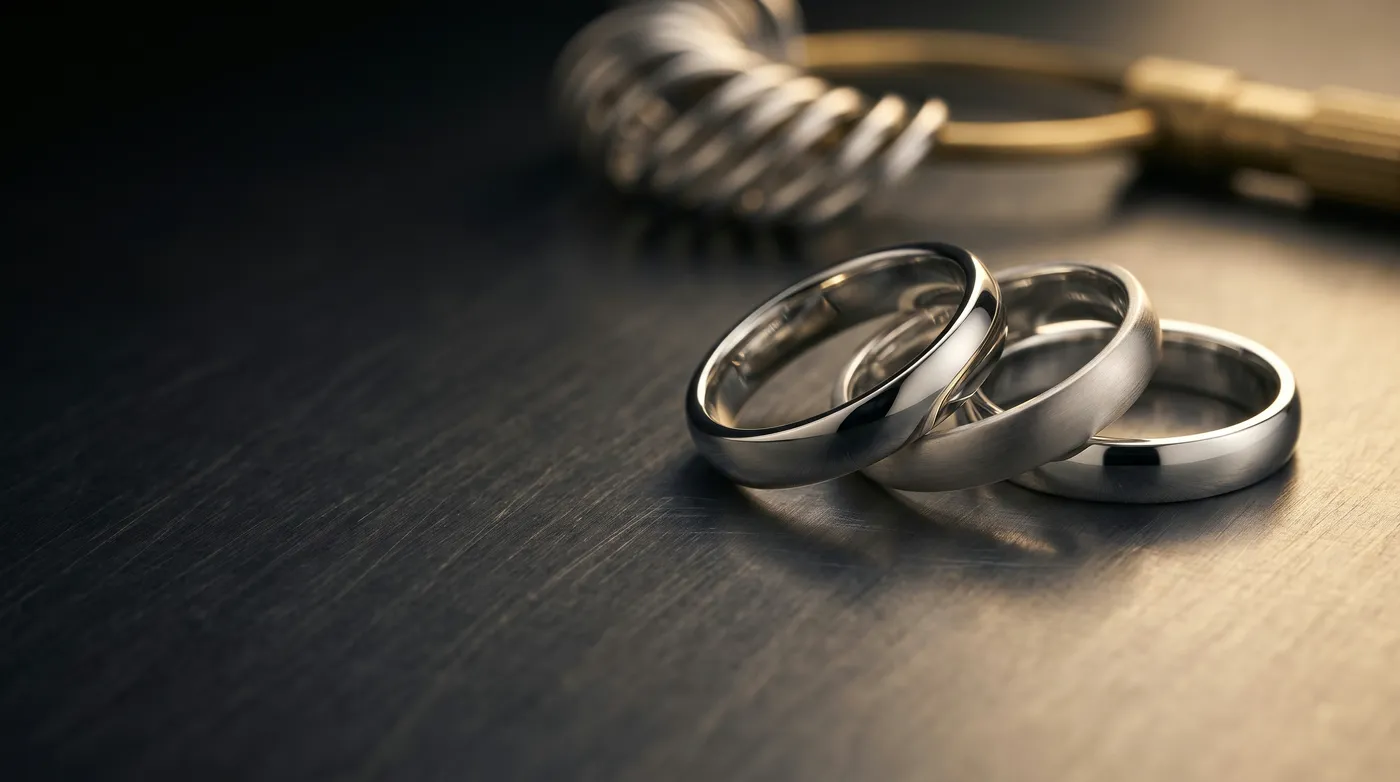

Someone places two rings in your hand: same shape, same width, both gleaming white. One is noticeably heavier. In the shop window, platinum, white gold and palladium look almost identical. You only notice the difference after years of door handles, steering wheels, dumbbells and bag straps. A ring worn every day is among the most heavily stressed pieces of jewellery. That is why it pays to choose the metal to suit the way you live.
Weight: density you can feel
Platinum is exceptionally dense. According to material data from the precious metals specialist Johnson Matthey, jewellery alloys with 950 parts per thousand platinum weigh in at 20.6 to 21.4 grams per cubic centimetre, palladium alloys with 950 parts per thousand at only 11.8 to 11.9 grams. The same ring therefore weighs around 1.8 times as much in platinum as in palladium. At 19.32 grams per cubic centimetre, fine gold is just below platinum; because its alloying metals are lighter, a white gold ring is lighter than its platinum twin. Weight shapes how a ring feels on the hand: some appreciate the heft as a sign of quality, others would rather forget they are wearing a ring at all. And it shapes the price, because precious metal is charged by weight.
Wearing away or moving aside
Every ring changes at the surface. What matters is how. A comparative study by Teresa Fryé, Ulrich E. Klotz and Tiziana Heiss, published in the Johnson Matthey Technology Review in 2021, subjected two platinum alloys with 950 parts per thousand, as well as 14 and 18 carat white gold containing nickel or palladium, to the same wear tests. The platinum alloys lost roughly a third as much volume as 18 carat palladium white gold and about half as much as the other white gold alloys.
The reason becomes clear when you look at individual scratches. The researchers distinguish two mechanisms: in micro-cutting, material is removed; in micro-ploughing, it is merely displaced. The soft platinum-iridium alloy showed mainly micro-ploughing: the metal migrated to the edges of the scratch instead of being lost. So platinum tends to ‘move’ rather than wear away. Notably, higher hardness did not reliably go hand in hand with lower loss in the study. The hardness figure alone is no measure of durability in daily wear. These are laboratory tests; your everyday life may differ.
This matters especially for set stones. The GIA describes platinum as denser and stronger than gold; platinum claws break less often, which is why it is well suited to setting diamonds.
Patina, rhodium and the white tone
Platinum develops a patina over time, a silky, slightly matt sheen made up of fine marks. Many value it as character; if you prefer a high shine, have the ring polished. White gold is usually rhodium-plated. The layer gradually wears away, the warmer tone of the alloy then shows through, and the ring needs re-plating from time to time. Some platinum rings are also rhodium-plated and then need the same care. Ask about this when you buy. Palladium is light, does not tarnish according to the GIA and is considered hypoallergenic. White gold containing nickel is unsuitable for people with a nickel allergy; more on alloys and allergies in the article Gold alloys and fineness.
Thinking of metal and stone together
A ring is only as suited to everyday wear as its most delicate element. The Mohs scale ranks gemstones by scratch hardness: diamond 10, ruby and sapphire 9, emerald, aquamarine and morganite 7.5 to 8, pearls just 2.5 to 4.5. The intervals are not equal; a diamond is many times harder than a sapphire. Important for daily life: dust often contains quartz, which has a hardness of 7. Stones with a hardness of 7 or less should therefore be cleaned gently; the GIA advises rinsing dust off rather than wiping it away. As a rule of thumb, the GIA considers stones of hardness 7 and above suitable for rings, and 8 and above ideal for daily wear.
But hardness is not toughness. A diamond resists scratches, yet it can cleave or break under a hard knock. Emeralds are naturally low in toughness and are often treated with oil or resin. And because setting metals are much softer than hard gemstones, it is usually the setting that wears. For an everyday ring, therefore:
- Stone: choose a Mohs hardness of 8 or above; wear stones around 7 in a protective setting.
- Delicate stones such as pearls are better reserved for pendants, earrings or special occasions.
- White gold: budget for rhodium plating as a recurring maintenance item, and ask about nickel.
- Platinum: embrace the patina or have it polished from time to time.
- Setting: have claws and bezels checked regularly by a goldsmith, especially after knocks.
Getting your ring size right
The international standard ISO 8653 defines ring size by the inner circumference in millimetres: size 54 corresponds to a circumference of 54 millimetres, roughly 17.2 millimetres in diameter. In Europe it has applied since 2026 as EN ISO 8653, replacing the 1992 version. Even so, you will come across several systems in shops: besides circumference, there is the inner diameter as well as British and American sizes. In the workshop, sizes are measured on a ring mandrel; at the jeweller’s, sizing rings with the same dimensions establish your size.
Fingers are not a fixed size. They swell over the course of the day and are slightly thicker in warm weather than in cold. So don’t measure straight after exercise or with cold hands, and ideally measure several times. The ring has to slide over the knuckle but must not slip around behind it. Wide rings often feel tighter than narrow ones of the same size, so have yourself measured with a sizing ring of similar width. Also find out before you buy whether, and by how much, the model can be resized later.
Measure in the late afternoon at normal room temperature and on two or three different days. If the readings fall between two sizes, the width of the ring decides: for wide models, the larger size is usually the better choice.
The upshot: platinum ages through displacement and patina, white gold through abrasion and a fading rhodium layer, while palladium wins people over with its lightness. None of them is the best metal across the board. The right one is the one whose ageing suits the way you live. The Ring Size Converter translates your size between the systems, and the Hardness Scale shows which stone can stand up to your daily routine. If you are choosing a diamond, you will find the differences between lab-grown and natural stones in the article Lab-grown or natural diamond.
Ring Size ConverterCircumference, diameter and international sizes at a glance. Hardness ScaleWhich stone can take what in daily life, ordered by Mohs.Frequently asked questions
Is platinum scratch-resistant?
No. Platinum gets scratched like any precious metal, but much of the material is displaced rather than removed in the process. This creates the typical patina, which can be polished away if you wish.
Does white gold have to be rhodium-plated?
No. Rhodium plating is a finish for a cooler white and a harder surface. Without it, white gold shows its own slightly warmer tone. If you want the cool white, have the layer renewed from time to time.
How are ring size, circumference and diameter related?
Under ISO 8653, the size corresponds to the inner circumference in millimetres; you get the diameter by dividing the circumference by π. British letter sizes and American number sizes are also widespread. The Ring Size Converter translates between the systems.
- Johnson Matthey, Jewellery: Platinum and Palladium Alloys (material data)
- LBMA, Density of Gold
- Fryé, Klotz, Heiss: Wear Resistance of Platinum and Gold Alloys. A Comparative Study, Johnson Matthey Technology Review 65 (3), 2021
- MJSA, A study of the wear resistance of platinum and gold alloys
- GIA 4Cs, Choosing Between White Gold, Platinum, Palladium, and Silver
- GIA 4Cs, Best Ring Material for Everyday Wear
- GIA 4Cs, Diamond Alternatives: Engagement Rings
- GIA 4Cs, More than the Mohs Scale
- GIA 4Cs, Garnet Engagement Ring: History, Meaning & Symbolism
- GIA 4Cs, Diamonds vs. Pearls
- CEN-CENELEC, Why a common language for ring size really matters (EN ISO 8653:2026)
- Estonian Centre for Standardisation, EVS-EN ISO 8653:2026
- Wikipedia, Ring size
- German-language Wikipedia, Ring size