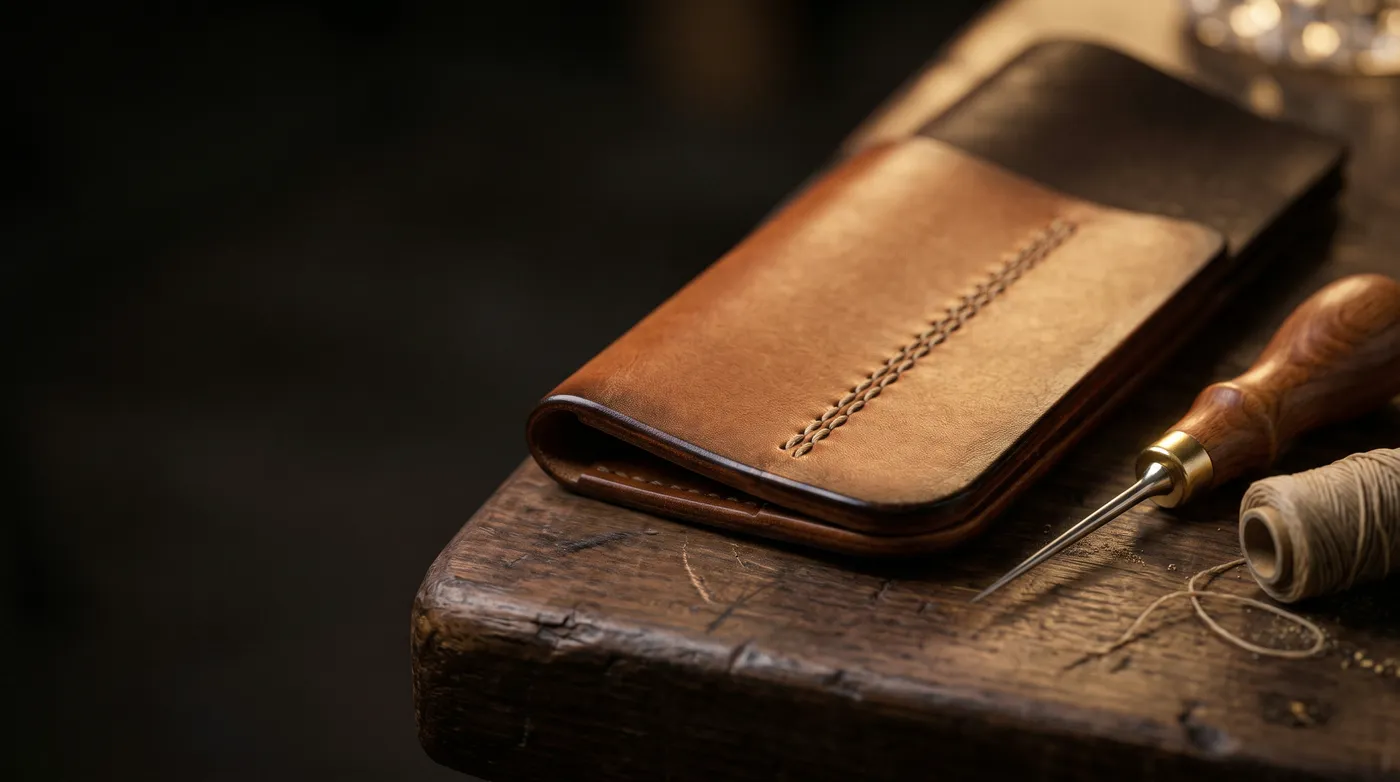

Pick up a bag and run your thumb over the surface. Can you see fine pores and small irregularities, a pattern that never quite repeats itself? Or a flawlessly even embossing that looks the same everywhere? This first impression alone reveals a lot about the leather used. The rest shows in places few people pay attention to: the edges, the seams and the inside.
Grain and layers: full-grain, corrected, split
A hide can be split horizontally into layers. The top layer carries the grain, the natural surface with the pattern of pores and hair follicles typical of each animal species. The layers beneath are called splits. There are international definitions for the key terms; the Leather Working Group summarises them in its list of definitions, based on ISO, CEN and UNECE definitions.
- Full-grain leather has kept its entire grain; none of it has been mechanically removed. Small natural marks are part of it and are not a defect.
- Corrected grain leather: here the grain has been partly buffed or similarly treated and then enhanced with a finish, often with embossing. This evens out irregularities in the surface.
- ‘Top-grain’ is a trade term, used mainly in the English-speaking world, that does not appear in the list of definitions mentioned. It is used inconsistently. Ask whether full-grain or corrected leather is meant.
- Split leather comes from a lower layer without grain. If the grain has been removed completely, the definitions say the word ‘leather’ should only be used with a qualifier, for example ‘split leather’ or ‘suede’. Split leather can be coated or embossed, and it then looks like grain leather from the outside.
- Leather fibreboard: if leather scraps are broken down into fibres and formed into sheets, with or without a binder, the result is not leather under these definitions.
The finish tells you something too. With aniline leather, the natural grain remains clearly visible; with pigmented leather, an opaque layer of colour covers the surface completely. The former shows signs of wear openly; the latter looks more uniform but also hides what lies beneath.
Tanning: vegetable or chrome
It is tanning that turns hide into leather. The tanning agents cross-link the collagen fibres; the material no longer rots and becomes more dimensionally stable and more resistant to stress and heat. According to the European Commission’s reference document for tanneries, 80 to 90% of all leather is tanned with chromium(III) salts.
Vegetable-tanned leather is made with tannins from sources such as chestnut, oak, mimosa or quebracho. It does not achieve the flexibility and heat resistance of chrome leather, but according to the EU document it has properties that only this type of tanning offers, such as its suitability for tooling and polishing. It is used for soles, belts, saddlery and leather goods, among other things. Neither type of tanning is better in itself; what matters is the purpose.
A word on chrome: tanning is done with trivalent chromium. However, chromium(VI), which can trigger allergies, can form in leather through the oxidation of chromium(III). For this reason, since 1 May 2015, leather articles that come into contact with the skin may not be placed on the market in the EU if they contain 3 milligrams or more of chromium(VI) per kilogram of the leather’s dry weight (Regulation (EU) No 301/2014).
Edges, seams, hardware, lining
The edge shows how much time has gone into a piece. Three finishes are common. With a folded edge, the leather is skived thin and wrapped around the cut edge. A painted edge is sanded and sealed with edge paint. A burnished edge is sanded and rubbed smooth. This technique requires vegetable-tanned leather. Whichever finish is used, look for even, smooth edges without cracks, bubbles or flaking paint.
When it comes to seams, the saddle stitch is regarded as a mark of handcraft: a single thread is passed with two needles from both sides through the same pre-punched hole. Sewing machines usually work with lockstitch, in which the upper and lower threads interlock within the material. Hand stitching is said to make a seam less likely to come apart if one stitch is damaged. But durability depends just as much on thread, stitch density and tension; a clean machine seam is no flaw. Good seams run straight, with stitches of equal length and secured thread ends.
Hardware such as buckles, rings, feet and zips should be firmly attached, cleanly deburred and work smoothly. Weight alone is no proof of quality; ask about the material and the surface, because coatings can wear off. The inside decides how a piece copes with everyday life: a good lining lies flat without creases, is neatly sewn in and is reinforced at stress points.
Look at the underside of a strap or the inside of a compartment first. Where hardly anyone looks is where you see most honestly how carefully a piece was made.
Labelling, care and storage
For shoes, material labelling is mandatory in the EU. Directive 94/11/EC requires the upper, the lining and sock, and the outer sole to be labelled, either with pictograms or in writing. The material stated is the one that makes up at least 80% of the surface area, or 80% of the volume in the case of the outer sole. This directive does not apply to bags and small leather goods. A general label such as ‘genuine leather’ also tells you nothing about which layer and finish were used. Ask specifically.
When it comes to care, less is more. Remove dust with a soft, dry cloth and test any product on an inconspicuous spot first, as the Canadian Conservation Institute, a government body specialising in the care of cultural heritage, also recommends. The manufacturer’s care instructions take priority, because different finishes react differently.
For leather in collections, the institute recommends a stable relative humidity of 45 to 55%. Above 65%, mould can grow; very dry air below 30% draws moisture out of the leather. Heat, for example near radiators, speeds up ageing, and leather should be kept out of direct sunlight. In everyday terms, this means keeping bags in shape with acid-free tissue paper, wrapping them in cotton and storing them neither in a damp cellar nor in a hot attic.
- Surface and description: a natural grain pattern or uniform embossing? Full-grain, corrected, split?
- Edges and seams: smooth, straight, even, with no loose ends?
- Hardware and lining: firm, deburred, crease-free, reinforced at stress points?
- Care: are there care instructions from the manufacturer, and is repair possible?
Quality in leather is not a question of shine but of the layer, the tanning and the care taken in places you cannot see. A well-made piece can be cared for and repaired, and so it stays in use for longer. Every additional day you wear it lowers its cost. What that means in figures is shown by the calculator below; the method behind it is explained in the article Cost per wear.
Cost per WearWhat a piece really costs each time you wear it, compared side by side.Frequently asked questions
Is full-grain leather always better than corrected grain?
Not in every case. Full-grain leather shows the natural surface with all its characteristics; corrected leather looks more even. What matters is that the type is stated openly and that the price and intended use match it.
How do I recognise vegetable-tanned leather?
Reliably, only from the manufacturer’s information. Burnished edges are a clue, because this technique requires vegetable-tanned leather.
How should I store a leather bag for a long period?
Kept in shape with acid-free paper, wrapped in cotton, away from radiators and direct sunlight, at an even humidity that is not too high. For collections, the Canadian Conservation Institute recommends a relative humidity of 45 to 55%.
- Leather Working Group, List of Definitions, Version 1.1 (January 2024)
- European Commission, Joint Research Centre: Best Available Techniques (BAT) Reference Document for the Tanning of Hides and Skins (2013)
- Regulation (EU) No 301/2014 amending Annex XVII to the REACH Regulation (chromium(VI) compounds)
- Directive 94/11/EC on the labelling of the materials used in the main components of footwear
- Canadian Conservation Institute, CCI Notes 8/2: Care of Alum, Vegetable and Mineral-tanned Leather