
The listing looks trustworthy: decent photos, a ‘full set’ with box and papers, a price just below the usual level. The seller is politely pushing, saying there are other interested buyers. This is the moment that decides whether a purchase on the secondary market goes well, not when you unpack it. If you check systematically, you can buy with more composure.
Papers, serial numbers, provenance
With watches and jewellery, the documents tell the story of a piece: warranty card or certificate, original invoice, service records, box. They are not proof of authenticity, because papers are forged too. Their value lies in consistency. Do the reference and serial numbers on the piece match the details in the documents? Do the purchase date, dealer and service history fit together? Gaps need not be a problem, but they deserve a plausible explanation.
You should see serial numbers on the piece itself, not just in photos. If a watch has been serviced, records of the work belong with it; what a service involves is explained in the article Servicing a mechanical watch. Ask about provenance too: under § 935 BGB (German Civil Code), ownership of stolen or otherwise lost items generally cannot be acquired, not even in good faith. Exceptions include items sold at public auction. A traceable chain of invoices therefore protects you as well.
Reports and inscriptions on gemstones
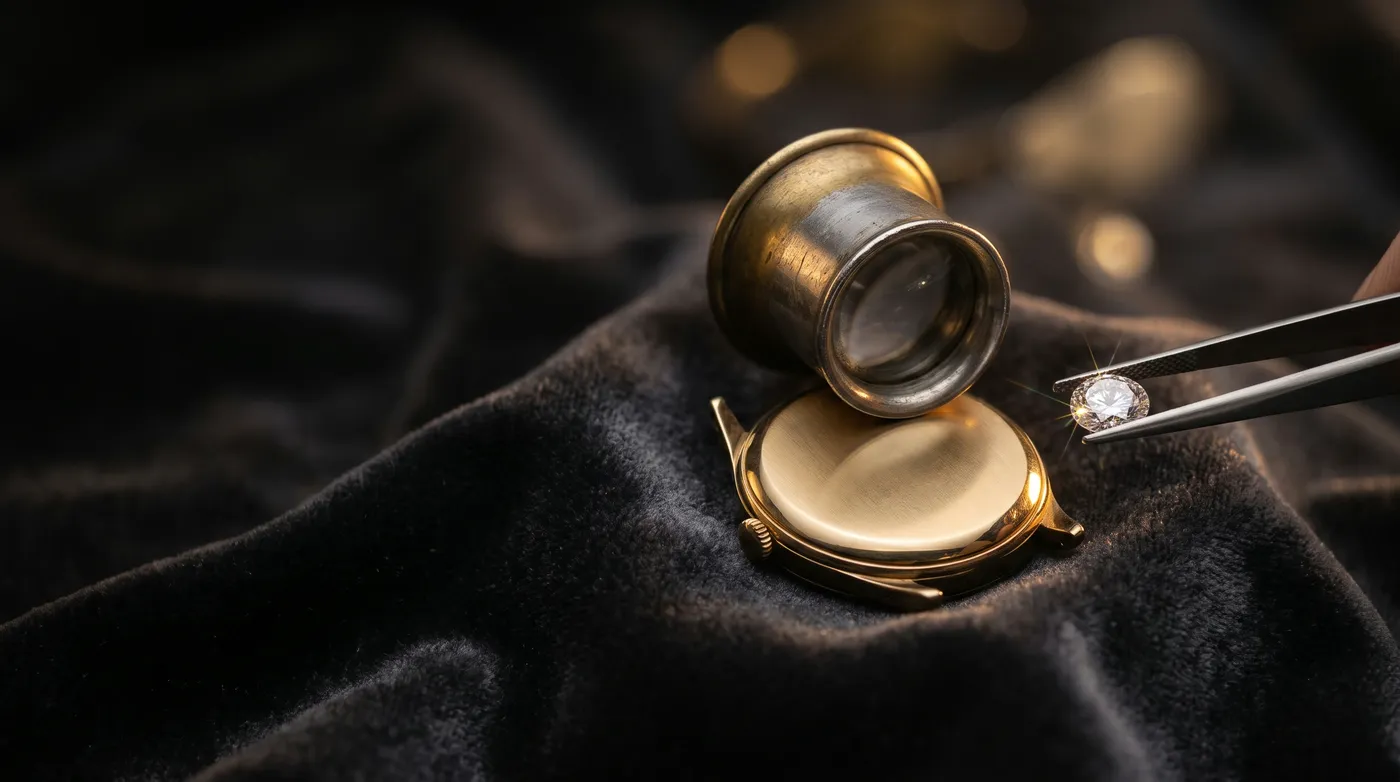
For diamonds, there are grading reports from independent laboratories that document weight, colour, clarity and cut. Some laboratories have the report number laser-inscribed on the girdle, the narrow edge of the stone. The Gemological Institute of America (GIA) points out that this microscopic inscription is visible under tenfold magnification with a jeweller’s loupe. The details of a GIA report can also be checked by number in an online database run by the institute.
So check three things: can the report be found in the laboratory’s database, does the inscription match the number, and do the stone’s measurements and characteristics fit? A report describes the stone, not the setting. Fineness marks such as 585 or 750 are not mandatory in Germany; anyone who applies them must comply with the German Fineness Act. On its own, a stamp proves very little, because it can be imitated. Find out more in the articles 333, 585, 750: what the stamp in your gold tells you and Lab-grown or natural diamond.
4C ExplorerUnderstand carat, colour, clarity and cut interactively.Dealer, platform or private seller: your rights
Dealers and platforms that check pieces themselves before selling them take on part of the work. How thoroughly they do so, and what happens if they get it wrong, is set out in their terms and conditions. ‘Checked’ can mean many things. Marketplaces usually only act as intermediaries; in a private sale, the checking is entirely up to you. Legally, what matters most is whether the seller is a business or a private individual. The following notes refer to German law, are general in nature and do not replace legal advice.
- Warranty from a dealer: claims for defects generally become time-barred two years after delivery (§ 438 BGB). For used goods, a business may shorten this period to one year for consumers, but only if it specifically points this out before the contract is concluded and the reduction is agreed expressly and separately (§ 476(2) BGB). If a defect appears within one year, it is presumed to have existed at the time of handover (§ 477 BGB).
- Buying from a private seller: here, liability for defects can be excluded by contract. However, the seller cannot rely on such an exclusion if they fraudulently concealed a defect or gave a guarantee as to the item’s condition (§ 444 BGB).
- Withdrawal from distance purchases: if you buy from a business online or by phone, you are generally entitled to a 14-day right of withdrawal (§§ 312g, 355 BGB). The period normally begins when you receive the goods (§ 356 BGB). The right applies to contracts between a business and a consumer (§§ 310(3), 312 BGB); it does not exist when you buy from a private individual.
- Auctions: at publicly accessible auctions that you can attend in person, the right of withdrawal is excluded (§ 312g(2) no. 10 BGB). For used goods, the special consumer rules of German sales law may also not apply there, provided this has been clearly pointed out (§ 474(2) BGB).
Fakes and warning signs
According to the Lower Saxony consumer advice centre (Verbraucherzentrale Niedersachsen), buying a counterfeit purely for private use is not prohibited in Germany, whereas reselling it is. Buying one can still prove expensive. For orders from online shops outside the EU, German customs (Zoll) states that even a single item can be deemed to be in the course of trade if the sender is acting commercially. In a case described by the Ulm Main Customs Office, the counterfeits were destroyed and the recipient faced costly civil proceedings brought by the trademark owners. Because it is almost impossible to tell whether genuine goods will be delivered when you order online from abroad, customs generally advises against such purchases.
- A price well below the usual level, often combined with time pressure.
- With online shops: a missing imprint (legal notice), incomplete contact details, conspicuous language errors or blurred images.
- Catalogue or third-party photos instead of pictures of the actual piece; excuses when you ask for close-ups of the serial number, clasp or inside.
- Papers whose numbers do not match the piece.
- Reviews that look commissioned, because comments can be faked too.
- A request for payment in advance by bank transfer, or for a payment without buyer protection.
Before any second-hand purchase, ask for three photos of the actual piece: the serial number, the back or inside, and a shot next to a handwritten note with today’s date. A seller who hesitates has already told you a great deal.
Paying and handing over safely
The payment method is your last line of protection. If you pay on invoice, you only pay once the goods have arrived. According to Germany’s consumer advice centres (Verbraucherzentrale), a direct debit can be reversed within eight weeks, and credit card payments can be reclaimed in some circumstances. Money sent by bank transfer, on the other hand, is hard to get back. PayPal’s buyer protection does not apply if you pay using the function for payments to friends.
For large sums, it is advisable to hand over the piece somewhere it can be examined before payment, for example at a watchmaker’s or a jeweller’s. Record the serial number, condition, what is included and the details on authenticity in the sales contract. The more specific the contract, the clearer it is in a dispute what was agreed.
- Compare the numbers on the piece with the documents and the grading report.
- Clarify whether the seller is a business or a private individual.
- Put the warranty and return terms in writing.
- Have the piece independently assessed: before you buy or, for distance purchases, within the withdrawal period.
On the secondary market, you buy not only a piece but also its history. If you compare the documents, know your rights and choose a payment method that can be reversed, you need not distrust every seller, but you should not trust any of them blindly either. The Glossary explains terms from girdle to fineness.
GlossaryFrom brilliant cut to balance wheel: terms briefly explained.Frequently asked questions
Is a watch without papers automatically suspicious?
No. Papers get lost, and they can be forged too. If documents are missing, however, examining the piece itself becomes more important, for example by an independent specialist workshop.
Do I have a right of withdrawal when I buy from a private seller via an online platform?
Under German law, the statutory right of withdrawal applies only to contracts between a business and a consumer. It does not exist when you buy from private individuals, even if the purchase is handled online. Platforms may have their own return or buyer protection rules.
What happens if customs stops a counterfeit I have ordered?
The goods can be detained and destroyed. According to the Verbraucherzentrale Niedersachsen, there may be costs for storage and destruction, and trademark owners may also assert civil claims.
- § 438 German Civil Code (BGB): Limitation of claims for defects
- § 444 BGB: Exclusion of liability
- § 474 BGB: Consumer goods purchase
- § 476 BGB: Deviating agreements
- § 477 BGB: Reversal of the burden of proof
- § 310 BGB: Scope of application (consumer contracts)
- § 312g BGB: Right of withdrawal
- § 356 BGB: Right of withdrawal in off-premises contracts and distance contracts
- § 935 BGB: No good faith acquisition of lost property
- Act on the Fineness of Gold and Silver Goods (FeinGehG)
- German Customs (Zoll), Trademark and product piracy (consignments from a non-EU country)
- German Customs (Zoll), press release from the Ulm Main Customs Office: Counterfeit trainers and clothing ordered (12 January 2023)
- Verbraucherzentrale Niedersachsen, Counterfeit brands: what to watch out for when shopping on holiday and online
- Verbraucherzentrale, Paying when shopping online: pros and cons of payment services
- GIA, 10 Tips for Buying a Diamond Online