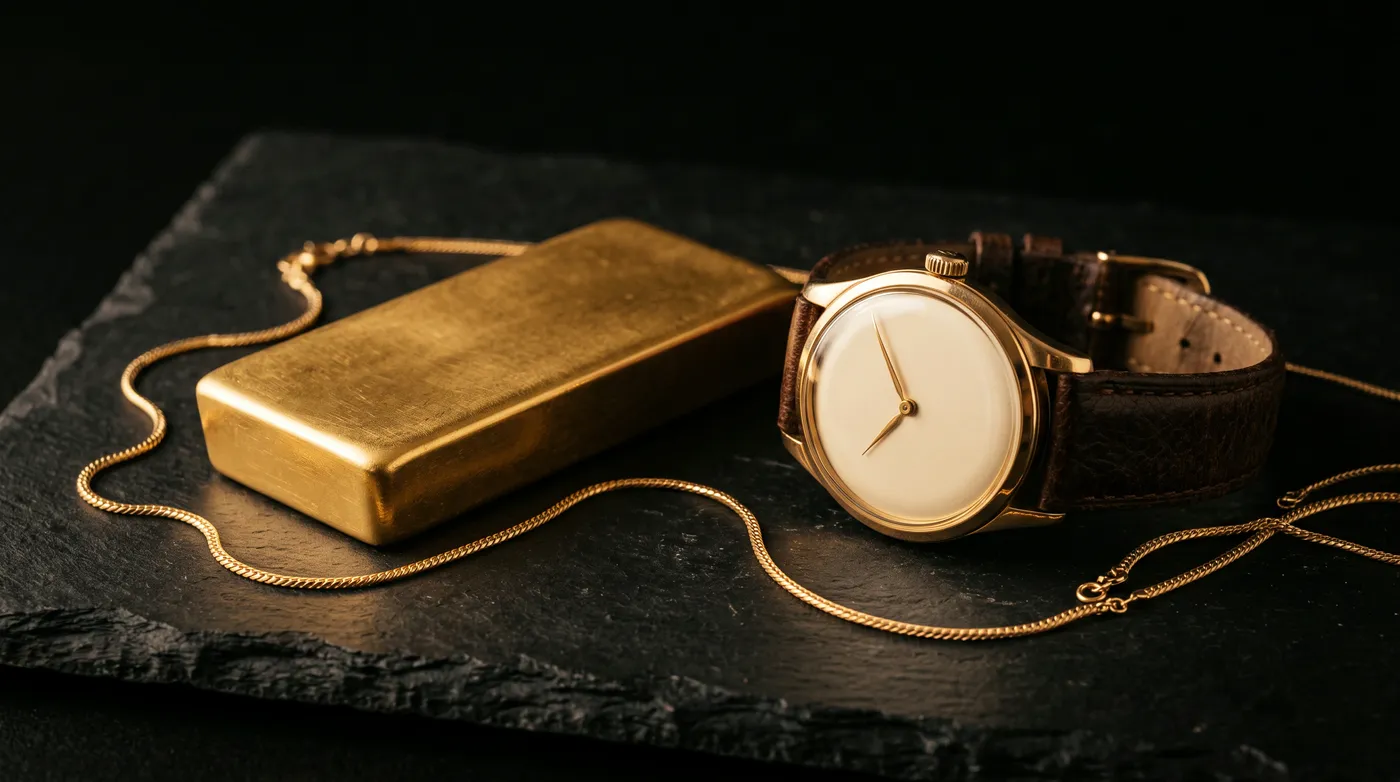

Luxury is considered crisis-proof. The figures paint a more nuanced picture: after the catch-up boom that lasted until 2023, the market for personal luxury goods has shrunk slightly two years in a row, and so have Swiss watch exports. Gold, on the other hand, the most important raw material for jewellery, cost 44% more on average in 2025 than in the previous year. This overview is based on three primary sources: the luxury study by Bain & Company and Altagamma, the export statistics of the Swiss watch industry federation FH and the data of the World Gold Council.
Market size: from slump to plateau
Bain puts the global market for personal luxury goods (fashion, leather goods, shoes, jewellery, watches, eyewear and beauty, at retail value) at €284 billion for 2019. In the pandemic year 2020 it fell to €223 billion; it recovered to €293 billion in 2021 and to €354 billion in 2022. It peaked in 2023 at €369 billion, followed by €364 billion in 2024 and €358 billion in 2025. At current exchange rates that is a decline of 2%; at constant rates, an increase of 1%. Including experiences such as luxury hospitality and fine dining, as well as cars, yachts and art, Bain arrives at around €1.44 trillion for 2025.
China, the US, Europe: where the buying happens
For 2025, Bain’s November estimates were as follows: China down 3 to 5% at constant exchange rates, Europe down 1 to 3% (held back by fewer tourists and a strong euro), the Americas between 0 and plus 2%, and the Middle East, the most dynamic region, up 4 to 6%. In Japan, growth lost momentum after a strong 2024, mainly because of declining tourism. The new markets (the Middle East, Latin America, South-East Asia, India and Africa) together reach around €45 billion, roughly the size of mainland China.
In its interim review of June 2026, Bain sees three speeds: the Americas are accelerating, China is recovering, while Europe as well as the Middle East and Africa are holding back. In Europe this is due to weak tourist flows; in the Middle East, to geopolitical tensions.
Who is buying: fewer customers, more weight at the top
According to Bain, the number of luxury buyers fell from around 400 million in 2022 to around 340 million in 2025, and new customer acquisition declined by about 5% from 2024 to 2025. Only 40 to 45% of the potential target group actually bought luxury, compared with around 60% in 2022. It is above all aspirational customers who have pulled back, while very wealthy buyers are supporting demand for high-end luxury.
Accordingly, the share of ‘big spenders’ grew from 30% (€88 billion) in 2019 to 45% (€165 billion) in 2024; in 2025 it is holding at around 46 to 47%. In early 2026, Bain is once again recording rising spending in the Americas, partly because aspirational customers are buying more.
Jewellery grows, watches polarise
Among the categories, jewellery leads the growth: Bain expected an increase of 4 to 6% for 2025, and in early 2026 jewellery remains the fastest-growing category. The watch market, by contrast, is splitting. High-end models are performing well, while tariffs and price pressure are fuelling the resale market. What to look out for there is explained in the article Buying pre-owned.
Swiss watch exports: two years in the red
The FH records export values, not final retail prices. After CHF 21.7 billion in 2019 and the slump to CHF 17.0 billion in 2020, exports rose to a record CHF 26.7 billion in 2023. This was followed by CHF 26.0 billion in 2024 and CHF 25.6 billion in 2025, a decline of 1.7%; the number of units fell by 4.8% to 14.6 million watches.
The most important market remained the US with CHF 4.35 billion, or 17% of exports (−0.5%), ahead of Japan (CHF 1.85 billion, −5.8%), China (CHF 1.80 billion, −12.1%), Hong Kong (CHF 1.80 billion, −6.5%), the United Kingdom (CHF 1.72 billion) and Singapore (CHF 1.63 billion). According to the FH, exports to China have collapsed by more than a third within two years. At the same time, record levels for the gold price and the Swiss franc made Swiss watches noticeably more expensive, particularly abroad.
US tariffs: a year of swings
The monthly figures show how strongly trade policy distorted the flow of goods. From 7 August 2025, additional tariffs of 39% applied to around 60% of Swiss exports to the US. On 10 December 2025, the Swiss federal government announced that the US was capping the additional tariff at a maximum of 15%, retroactive to 14 November 2025. Watch exports to the US reached CHF 853.4 million in April 2025 and CHF 554.5 million in July. In August they fell to CHF 245.1 million, and in September to CHF 157.7 million. According to the FH, the swings largely balanced out over the year. From January to September 2026, total watch exports, at CHF 19.5 billion, were 2.7% higher than in the same period of the previous year.
Gold: the raw material behind jewellery
The benchmark for the gold price is the London afternoon price, the LBMA Gold Price PM. As an annual average, it rose from $1,160.1 per troy ounce in 2015 to $1,769.6 in 2020 and $2,386.2 in 2024, reaching $3,431.5 in 2025 (+44%). In 2026, the quarterly average was $4,872.9 in the first quarter and $4,506.3 in the second. At the end of the third quarter, the European Central Bank valued gold at €3,688.86 per troy ounce, around €118.60 per gram of fine gold.
For jewellery, this cuts both ways. According to the World Gold Council, global demand for gold jewellery fell by 18% in volume in 2025 to 1,542 tonnes, while its value rose by 18% to a record $172 billion: buyers spent more and received less gold. In the second quarter of 2026, volume fell to 278 tonnes, the lowest quarterly figure since the pandemic; according to the WGC, high gold prices and inflation weighed on affordability. Spending, at $40 billion, was nevertheless 14% higher than in the same quarter of the previous year. How strongly the gold price feeds through to a piece of jewellery depends on its fineness. Read more in 333, 585, 750: what the stamp in your gold tells you and in the metal comparison Platinum, white gold, palladium.
Luxury MonitorLuxury market, watch exports and gold price in charts with sources.You can roughly estimate the pure material value of a piece of gold jewellery yourself: weight in grams × fineness (0.75 for 18ct gold, hallmarked 750) × gold price per gram. Craftsmanship, stones, brand and trade margin come on top and help determine the shop price.
Putting it in context
All of these figures are snapshots: Bain makes estimates on the basis of company data and expert interviews and revises previous years retrospectively, the FH reports export prices, and the gold price fluctuates daily. Bain’s realistic scenario for 2026 (growth of 2 to 4% at constant exchange rates) is an expectation, not a fact. This article is not investment advice. How a purchase adds up over the years is shown in the article Cost per wear.
Frequently asked questions
How big is the global luxury market?
Bain & Company and Altagamma put the market for personal luxury goods at €358 billion in 2025, after €364 billion in 2024 and the peak of €369 billion in 2023. Including experiences, cars, yachts and art, the total comes to around €1.44 trillion.
Do watch exports show how much Swiss watches sell for in the shops?
No. The FH records export values at export prices, not final retail prices. In 2025 they totalled CHF 25.6 billion. The figures show trends and markets, but not the turnover of individual brands or retailers.
Does a high gold price make jewellery more expensive?
The material share rises with the gold price; by how much depends on weight and fineness. According to the World Gold Council, customers bought 18% less gold jewellery by volume in 2025 but spent 18% more on it, a total of $172 billion.
- Bain & Company, press release ‘Bain-Altagamma Luxury Study 2025’ (24 November 2025)
- Bain & Company, ‘Luxury Is Ready for a New Era After Stabilizing in 2025’ (20 November 2025)
- Altagamma-Bain Luxury Goods Worldwide Market Study Spring 2026 ‘Rhapsody in luxury’ (25 June 2026, PDF)
- Federation of the Swiss Watch Industry FH, press release ‘Swiss watch exports 2025’ (29 January 2026)
- FH, World watchmaking in 2025
- FH, Swiss watch exports by market (as of October 2026)
- FH, Swiss watchmaking in September 2026
- Swiss Confederation, ‘US tariffs: Federal Council adjusts negotiations’ (4 August 2025)
- Swiss Confederation, ‘Reduction of additional US tariffs enters into force retroactively’ (10 December 2025)
- World Gold Council, Gold Demand Trends Full Year 2025
- World Gold Council, Gold Demand Trends Q2 2026
- European Central Bank, Consolidated weekly financial statement of the Eurosystem as at 2 October 2026 (quarter-end revaluation)